
About
The Center for the Development and Application of Internet of Things Technologies (CDAIT) was a global partner-funded center of excellence in IoT designed to advance the development of interdisciplinary Internet of Things (IoT) research and education that connected industry partners with Georgia Tech researchers, students and faculty, as well as other collaborators who share similar interests. CDAIT’s aim was to foster industry creativity, productivity gains, and growth while addressing critical societal issues such as inclusivity, privacy, trust, ethics, regulation and policy.
Past Research
Student IoT Challenge
The Student IoT Innovation Capacity Building Challenge was a CDAIT initiative to advance the development of innovation, applications, policy, and activities, broadly, in the area of Internet of Things (IoT) technologies and applications. CDAIT sought to stimulate projects involving rapid response innovative/exploratory research, hardware/software projects, policy and applications, and efforts to advance ideas into prototyping and early commercialization phases. The IoT Challenge took place for four years and saw numerous project teams with remarkable research. An overview of the projects from each year is below.
2024 Challenge Winners
IoT Emerging Innovation Prize: IoT Oyster Mushroom Farmer: An autonomous oyster mushroom farming IoT device for the home
As urban populations grow, it will become more important to grow food inexpensively near urban centers. This project outlined the creation of an autonomous oyster mushroom farming IoT device capable of farming oyster mushrooms from inoculation to harvest. The device consisted of a Raspberry Pi Pico for real-time data collection and actuation, a Raspberry Pi 5 for camera actuation and connectivity, and a frontend web server portal to monitor the growing mushrooms.
Policy/Civic Engagement Prize: Designing Evidence-Based Training for Developing Technology Mastery in Older Adults with Mild Cognitive Impairment
This research aimed to create a set of guidelines for designing instruction and training materials for older adults with Mild Cognitive Impairment (MCI). Through this research project, the research team tested and confirmed the validity and effectiveness of their developed guidelines using an “Action Research” methodological framework and a pre-and post-test training design. Results revealed that implementing the guidelines effectively improved users’ knowledge and attitudes of a commercially available wearable health monitoring device, the Oura ring, and its accompanying app. Post-training focus group results demonstrated the effectiveness of instruction and training programs derived from their developed guidelines. This study has important academic, user, and organizational implications. As such, the research team hope's this work will enhance the quality of life for older adults by improving their technology mastery and self-efficacy, which has been shown to impact their ability to maintain autonomy while aging.
Verizon Connectivity Prize: BS4LIES: Backscatter 4 Low-power IoT Environmental Sensing
The backscatter-based sensing system for low-power IoT environmental monitoring was created to target the use-case of monitoring urban heat islands in Atlanta by creating a temperature-sensing backscatter device. The research team's approach combined digital data communication techniques with low-power digitization and signal communication for multiple nearby tags to transmit hyperlocal temperature information to a custom centralized base station. The system was designed to eventually operate on harvested energy and transmit data over distances exceeding 50 meters from any external infrastructure, though the intermediate prototype we present here runs on battery power and achieves a range of 14 meters. This project explored methods such as forward error correction (FEC), signal modulation, and power-efficient design to achieve reliable communication.
IoT Commercial Applications Prize: Medi-Runner: Autonomous Indoor Patient Medical Supply Delivery System
In medical facilities, nurses and healthcare professionals often face time constraints when distributing essential supplies and monitoring patients. This project aimed to address this by introducing an Autonomous Robot Delivery and Patient Monitoring system tailored for medical environments. Utilizing the Robot Operating System (ROS), this solution integrates lidar-sensor technologies and computer vision to autonomously navigate the facility. By implementing simultaneous localization and mapping (SLAM), object detection, and path planning algorithms, the robot optimally determined routes to deliver requested medical supplies and essential equipment to specific locations. Furthermore, it interacted with patients in the absence of nurses, contributing to patient care and reducing workload. In case of emergencies detected by the robot’s vision system, human operators were notified to intervene. This innovative system merges the fields of healthcare, IoT, and autonomous technology, offering reliable delivery of supplies and enhanced patient support while pushing the boundaries of inclusive IoT applications in medical settings.
2023 Challenge Winners
1st place - Verizon Connectivity Prize: Water-level Accessible Via Economical Satellites (WAVES)
The Georgia Tech Smart Sea Level Sensors (SSLS) project previously developed and deployed internet-connected water level sensors that require collocation with existing internet infrastructure, limiting possible deployment locations. Low-cost satellite constellations such as Swarm present a viable connectivity alternative, allowing sensors to upload data from anywhere. For this project, the WAVES team redesigned the Smart Sea Level Sensor’s water level sensor to integrate with a Swarm M138 satellite gateway, allowing the system to upload water level data and system metadata multiple times a day from anywhere in the world. More info at: https://www.sealevelsensors.org/
1st Place - Policy/Civic Engagement: Physioconnect: Cloud-interfaced Wearable Device Ecosystem for Cardiovascular Characterization and Remote, Long-term Postpartum Monitoring
In the United States, the sole postpartum visit that is currently part of standard postpartum treatment occurs between 4 and 6 weeks after child delivery, which is too late to diagnose cardiomyopathy, heart failure, or hypertensive crisis. To begin to address the underlying inequalities in access to healthcare infrastructure producing this disparity, we apply a comprehensive multifaceted framework to a platform for real-time delivery of key maternal cardiovascular metrics to patients and their clinicians using modern cloud and mobile application technology in conjunction with skin-like wearable devices with clinic-grade sensing ability. With the intersection of cardiovascular and socioeconomic factors at the center of postpartum risk assessment, an accessible, accurate, and continuous monitoring system would be a central component of a broader proactive approach for mitigating the rising postpartum death in the United States. More info at: https://sites.gatech.edu/physioconnect/
1st place - IoT Innovation: Soft Upper-Extremity Robotics with Stretchable Artificial Skin Electronics for Deep Learning-Enabled Human Strength Augmentation
The team developed a soft upper-extremity exoskeleton created for the purpose of human strength augmentation that was built upon a new class of technologies, including stretchable artificial skin electronics, soft actuators, and deep-learning algorithms. To create the soft sensors and electronics needed in a rapid and reliable manner, they implemented nanomaterial printing methods. These sensors and actuators were then be integrated with a soft robotic garment, and deep-learning algorithms offer automatic, real-time identification and classification of the user’s movement for facilitating and amplifying the intended motion.
Development of an Immersive System for Effective Training in Industrial Laser Scanning
ScannerVR is a simulation tool enabling instructors and trainees to understand the complexities of the laser scanning process. Trainees and instructors can leverage the power of VR to enable the instruction of complex tasks. The trainee puts on the headset and is then greeted by instructions on how to use ScannerVR. Movement controls and Interaction controls are explained along with the objectives of the experience. The trainee is then dropped into the virtual industrial environment, where they can immerse themselves in the scanning experience. The instructor can monitor the interactions while the trainee uses the headset to accomplish. More info at: https://abhishekshankar.gitbook.io/scannervr/
Thermal Display for Augmenting Emotional Experience
Conventional IoT devices rely on visual displays to deliver information. Yet, multimodal outputs beyond the visual offer under-explored possibilities for information displays. For example, physical warmth has been shown to increase social warmth and offers a deep sense of comfort and coziness. The team has designed and implemented a thermal display, and developed and exhibited Thermal Music as an example of using it to express feeling through heat. Plans are to miniaturize the thermal display and extend the feeling communication beyond music (e.g., presenting nuanced information from IoT devices, sharing the state of people and the environment, and encouraging a specific action by influencing feelings).
2022 Challenge Winners
1st Place - Commercialization: Intelligent Acoustic Monitoring at the Edge
This project is a low-cost, easy-to-implement application that uses a microphone to learn what a machine typically sounds like and alerts users when anomalous sounds are identified. The application makes use of unsupervised machine learning to automate all stages of deployment including the determination of machine state, learning the typical sound of the machine, and setting the threshold for classifying new sounds.
1st Place -Technology Development: Soft Stethoscope Patch (SSP) for Multi-patient Pulmonary Diagnosis
This project consists of three soft stethoscope patches, on the chest, back right and left lower lobes, connect to a HIPAA compliant application with integrated machine learning algorithms to classify abnormalities and send real time severe event notifications to a caregiver. This system provides accurate, continuous, and timely cardiopulmonary information on patients requiring accurate multi-auscultation.
2021 Challenge Winners
1st Place: Wearable Stress Monitoring System
This project, a novel IoT system that consists of a soft sternal patch with optimized mechanics that wirelessly monitor minute mechanical vibrations on the chest caused by each heartbeat, and an android app that conducts real time signal processing and machine learning to identify markers of cognitive stress.
2nd Place: Elbowroom
The objective of the Elbowroom project was to build a novel, Automated Passenger Counter (APC) system to offer transit agencies, especially smaller organizations, access to rider occupancy data. The team chose to use Bluetooth and WiFi sensors as their main data source due to their low price.
Bridges of the Beltline
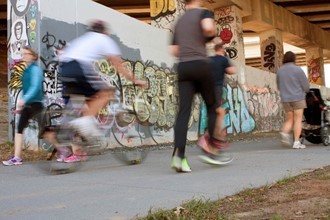
The Atlanta BeltLine is a walkable and bikeable path that connects neighborhoods, providing residents and visitors an attractive alternative to driving. When complete, the Atlanta Beltline can unify once divided areas, engendering greater community connectedness and economic viability. It weaves under, over, and through a multitude of overpasses, footbridges, and tunnels. As in any city, a significant feature is simultaneously an asset and a potential hazard. These types of structures are “vulnerable critical facilities” that should be included in emergency risk assessments and mitigation planning.[ii] Bridges of the BeltLine was a mixed-methods study to understand how the BeltLine can be used as an emergency management asset.
The project’s findings could break new ground on how to analyze the emergency use of similar pathways, at a time when many cities are looking at rails-to-trails projects. As such, this project was responsive to the United Nations’ sustainable goals nine “Build resilient infrastructure, promote inclusive and sustainable industrialization and foster innovation[iii]” and eleven “Make cities and human settlements inclusive, safe, resilient and sustainable.[iv]” The work of Bridges of the BeltLine is scalable to encompass the fully developed Atlanta BeltLine eventually, and its findings can be transferable to other cities around the nation and globe which have similar multi-use pedestrian pathways.
A final report of this study can be found at this link.